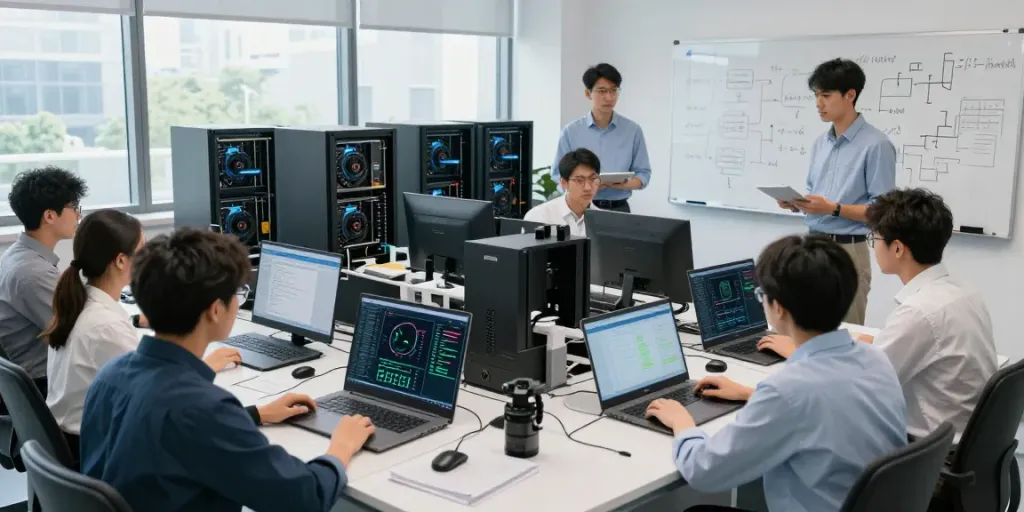
Understanding GPU Computing
In today's rapidly evolving technological landscape, GPU computing has emerged as a cornerstone of high-performance computing, particularly within the realm of artificial intelligence (AI). Graphics Processing Units (GPUs) are not just the backbone of modern gaming; they have also transcended their original purpose to become powerful facilitators of various computational tasks, especially those that require parallel processing capabilities. This article delves into the intricacies of GPU computing, its evolution, and its critical importance in the AI ecosystem.
What is GPU Computing?
GPU computing refers to the use of a Graphics Processing Unit to perform computations that are typically handled by the Central Processing Unit (CPU). This technology allows for the execution of many operations simultaneously, taking advantage of the GPU's parallel structure to accelerate data processing tasks. The versatility of GPUs makes them suitable for a wide array of applications, ranging from graphics rendering to complex scientific calculations.
The Evolution of GPU Technology
Initially designed for rendering images and video game graphics, GPUs have evolved significantly since their inception. The introduction of General-Purpose computing on Graphics Processing Units (GPGPU) enabled researchers and developers to leverage the massive parallel processing capabilities of GPUs for non-graphical tasks. This paradigm shift has opened up new frontiers in computing, allowing for breakthroughs in machine learning, deep learning, and data analytics.
Differences Between GPU and CPU Computing
The fundamental distinction between GPUs and CPUs lies in their architecture. While CPUs are optimized for sequential task execution and can handle a limited number of operations at a time, GPUs are designed to perform thousands of simultaneous operations. This makes GPUs inherently more efficient for tasks that can be parallelized, such as matrix multiplications in neural networks.
The Importance of GPU Computing in AI
As AI continues to gain traction across industries, the demand for GPU computing has surged. By facilitating faster data processing and enabling the training of complex models, GPUs have become indispensable in advancing AI technologies.
How GPUs Enhance AI Workloads
GPU computing significantly enhances the performance of AI workloads by speeding up the computations involved in training large models. Tasks that could take hours or even days on a CPU can often be completed in minutes with a GPU, making them essential for machine learning applications. For instance, training a convolutional neural network (CNN) on a dataset can yield results several times faster when using GPUs compared to traditional CPU-bound methods.
Benefits of GPU Computing for Data Processing
- Speed: GPUs can handle multiple computations concurrently, dramatically reducing processing time.
- Scalability: The architecture of GPUs allows for scaling out with multiple units to handle larger datasets.
- Energy Efficiency: Despite their processing capabilities, GPUs can be more power-efficient than CPUs for specific workloads.
Case Studies in AI Achievements Using GPUs
Numerous organizations have successfully harnessed the power of GPU computing to achieve significant advancements. For example, NVIDIA's GPUs have been pivotal in training large language models, such as GPT-3, which require immense computational resources. Similarly, researchers at Google have employed GPUs for image and speech recognition tasks, achieving state-of-the-art results in various benchmarks.
Selecting the Right GPU for Your Needs
When considering the integration of GPU computing into your operations, it’s crucial to select the right GPU that aligns with your specific needs and workloads.
Categorizing GPUs: Gaming vs. Data Center
GPUs can generally be categorized into two segments: consumer-grade (gaming) GPUs and data center (professional) GPUs. While gaming GPUs are optimized for graphics performance, data center GPUs are designed for compute-intensive tasks and often come with enhanced reliability and support.
Top Brands and Models in 2026
As of 2026, some leading brands in the GPU market include NVIDIA, AMD, and Intel. Notable models such as the NVIDIA A100 and AMD MI250 are specifically engineered for data centers and AI workloads, providing exceptional performance and efficiency.
Factors to Consider When Choosing a GPU
Several factors influence the decision in selecting a GPU, including:
- Performance Requirements: Assess the computational needs of your applications.
- Memory Capacity: Ensure the GPU has sufficient memory for handling large datasets.
- Power Consumption: Evaluate the energy efficiency, especially for large-scale deployments.
- Compatibility: Check compatibility with existing systems and software frameworks.
Challenges in GPU Computing
Despite the advantages, GPU computing also presents several challenges that organizations must navigate.
Common Misconceptions about GPU Use
One common misconception is that GPUs are only beneficial for gaming or graphics-related tasks. In reality, their parallel processing capabilities are invaluable in various fields, including scientific simulations, financial modeling, and machine learning.
Performance Issues and Solutions
Performance bottlenecks can arise from poorly optimized code or hardware limitations. To mitigate these issues, it's crucial to use appropriate libraries and frameworks designed for GPUs, such as CUDA or TensorFlow, to fully leverage their capabilities.
Managing Costs and Resources Effectively
Implementing GPU computing can entail significant costs, particularly for high-performance models. Organizations should consider cloud-based GPU services or shared resource models to manage expenses effectively while accessing necessary computational power.
The Future of GPU Computing
As AI applications continue to proliferate, the role of GPU computing is set to expand further, with numerous trends shaping this technological evolution.
Emerging Trends in GPU Technology
Trends such as the integration of GPUs with AI hardware, the rise of edge computing, and advancements in GPU architecture are set to redefine how we utilize these powerful computational resources. The development of specialized chips for AI tasks, such as TPUs, may also impact GPU relevance.
Predictions for GPU's Role in AI and Beyond
Looking ahead, GPUs are expected to play a crucial role in the transition toward more efficient AI algorithms and training methodologies. As data grows exponentially, the ability of GPUs to process large-scale datasets will be indispensable.
Strategies to Prepare for Future Developments
Organizations should remain adaptable by continually evaluating their computing infrastructure and staying abreast of technological advancements. Investing in training for staff on GPU utilization and optimization techniques will also be beneficial.
What are the benefits of GPU computing?
GPU computing provides significant benefits, including enhanced processing speeds, the ability to handle large datasets efficiently, and cost-effectiveness in executing parallel tasks.
How does GPU computing support AI applications?
By accelerating the training and inference of AI models, GPU computing plays a crucial role in deploying AI applications successfully in real-time scenarios.
What should I look for when buying a GPU?
It’s important to consider the performance specifications, memory size, compatibility with your system, and power consumption when selecting a GPU.
Can GPUs be used for tasks other than gaming?
Absolutely! GPUs are widely used in AI, scientific computing, data analytics, and machine learning, among other applications.
What are the best practices for GPU utilization?
Best practices include efficiently utilizing GPU resources by optimizing workloads, leveraging suitable programming libraries, and maintaining hardware to prevent thermal throttling.